
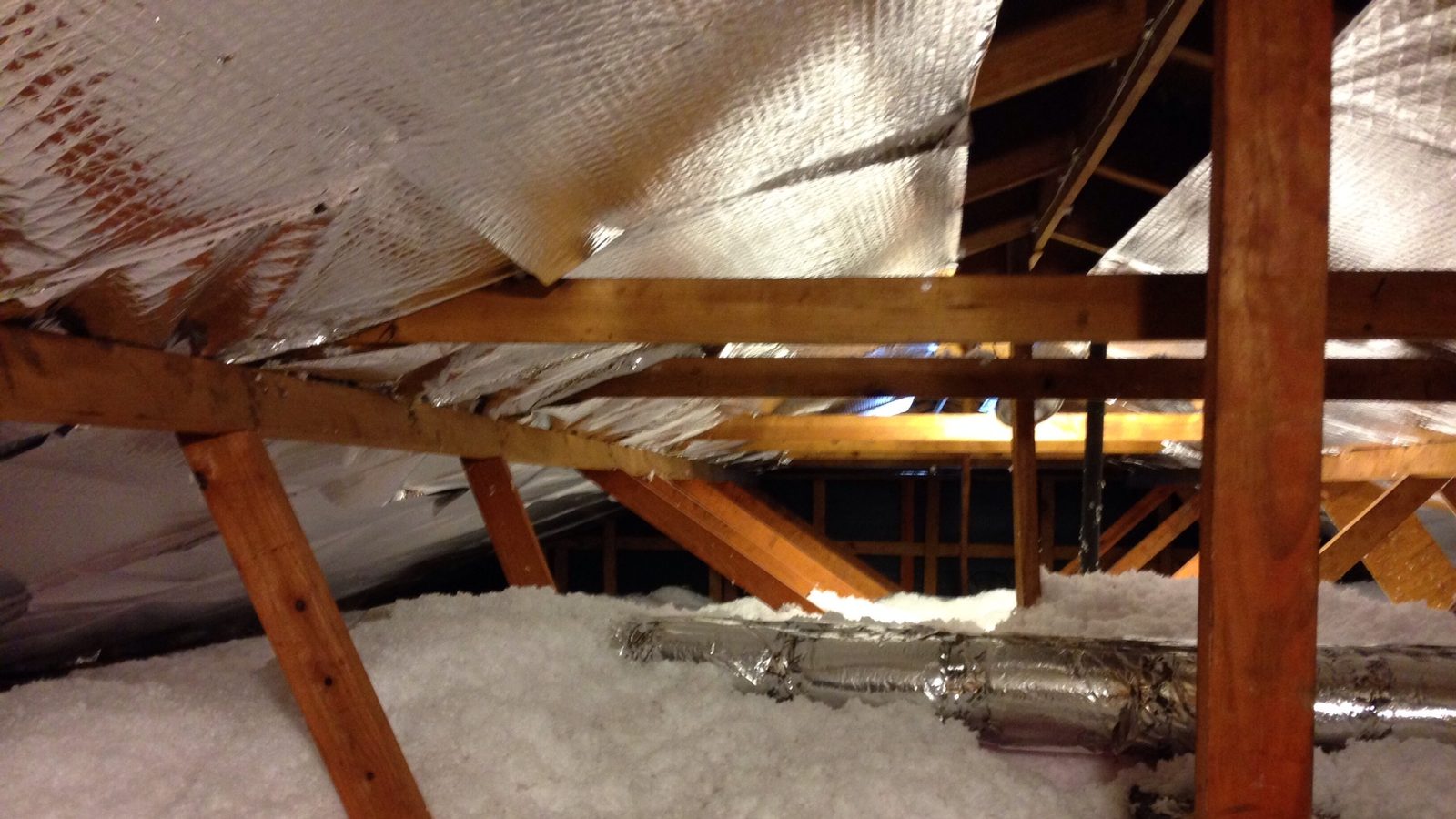
In a Florida home, the attic is where the battle against heat is won or lost. On a summer afternoon an attic can reach 130–150°F — far hotter than the air outside — and all that heat is sitting directly above your living space, looking for a way down. Understanding how that heat moves is the key to keeping your home comfortable and your power bill in check, because each kind of heat is stopped by a different solution.
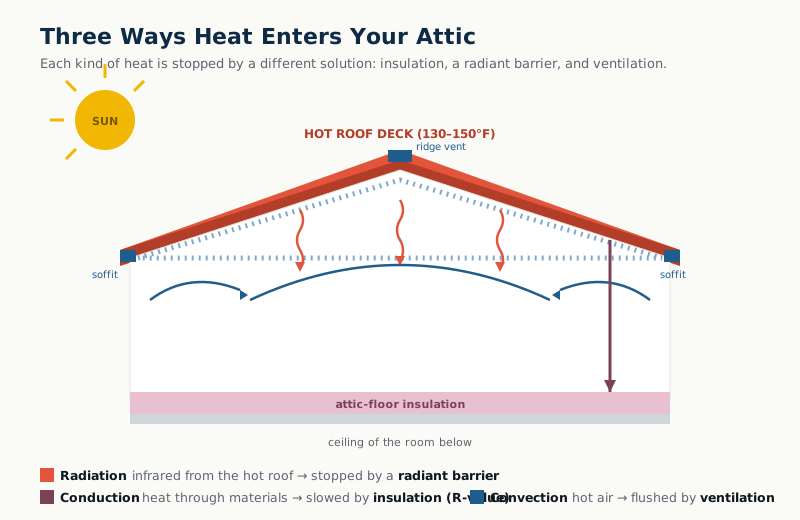
The three ways heat moves into your home
Heat travels in three different ways, and your attic deals with all three at once.
Conductive heat — heat through materials
Conduction is heat moving directly through a solid material — the way a metal spoon gets hot in a pot of soup. In your attic, the hot roof and framing conduct heat downward through the structure and into the ceiling below. The tool that fights conduction is insulation, rated by its R-value: the higher the R-value, the more it slows conductive heat from reaching your ceiling. This is why attic insulation depth matters so much in Florida — it’s your main defense against conducted heat.
Radiant heat — heat across open space
Radiation is heat traveling as invisible infrared energy across an open space — the way you feel the sun on your skin, or heat coming off a campfire, without touching it. Your superheated roof deck radiates heat downward onto everything in the attic: the top of your insulation, your ductwork, and your stored belongings. Here’s the key point most homeowners miss — ordinary insulation slows conduction but does very little against radiant heat. The tool that fights radiation is a radiant barrier: a reflective foil layer (often stapled to the underside of the roof rafters) that reflects radiant heat back toward the roof instead of absorbing it. In Florida’s intense sun, a radiant barrier can noticeably lower attic temperatures and the cooling load below.
Convective heat — heat carried by moving air
Convection is heat carried by moving air — hot air rising and circulating. A sealed-up attic traps that superheated air, which then drives heat down into the house and bakes the roof from below, shortening its life. The tool that fights convection is ventilation: intake vents low at the soffits and exhaust vents high at the ridge let hot air flow out while cooler air flows in, continuously flushing heat from the attic.
Put together: a well-built Florida attic uses insulation for conduction, a radiant barrier for radiation, and ventilation for convection. Miss one and the other two have to work harder — and your power bill shows it.
How attic ventilation actually works
Good ventilation is a balanced in-and-out path:
- Soffit vents (low, under the eaves) bring cooler air in.
- Ridge vents (along the peak) let the hottest air escape.
- Gable or off-ridge vents serve the same exhaust role on some roof shapes.
- Powered fans can help in specific cases, but a well-designed passive system is often enough.
When intake and exhaust are balanced, the attic “breathes,” staying closer to outdoor temperature instead of trapping a furnace’s worth of heat over your bedrooms.
Why the Florida attic is high-stakes
Beyond heat, attics are where hidden problems hide:
- Moisture and mold. Humid air plus cool surfaces equals condensation, and an attic is a prime spot for it. A roof leak shows up here first, soaking insulation (see roof care).
- Bath fans venting into the attic. A surprisingly common defect that dumps warm, moist air right where it causes the most damage. Exhaust fans must vent outside, not into the attic.
- Ductwork in the attic. Cooling air travels through ducts in that 140°F space; leaky or poorly insulated ducts waste a large share of what you’ve paid to cool.
- Compressed or missing insulation. Foot traffic, stored items, and old work leave gaps that quietly raise your bill.
Signs of an attic problem
- Upstairs or single-story rooms that never quite cool down.
- Power bills climbing through the summer.
- A musty smell, or visible staining and dark spots on the underside of the roof deck.
- Insulation that looks thin, uneven, or damp.
Keeping attic costs low
- Confirm your insulation depth and coverage, and top up thin spots.
- Keep soffit and ridge vents clear so air can actually move.
- Make sure every exhaust fan vents outside, not into the attic.
- Address roof leaks immediately, before they ruin insulation.
- Seal and insulate ductwork that runs through the attic.
Radiant barrier or more insulation — which comes first?
Homeowners often ask whether to add a radiant barrier or more insulation. They solve different problems, so the right answer depends on what your attic is missing. If your insulation is thin or uneven, add insulation first — it’s the foundation, and it addresses the conductive heat that makes up the bulk of the load. If your insulation is already adequate but your attic still runs brutally hot, a radiant barrier is the logical next step, because it tackles the radiant heat that insulation alone can’t. In many Florida homes the best results come from doing both, in that order: bring insulation up to recommended levels, then add a radiant barrier to knock down the radiant load. An inspection that measures what you actually have takes the guesswork out of the decision.
Why an annual look matters
Almost nothing in your attic is visible from your living space — which is exactly why it’s worth a yearly professional look. Thermal (infrared) imaging is built for this: because it sees heat directly, it reveals missing or wet insulation, radiant hot spots, and air leaks the eye can’t catch. It’s the same physics this article is about — infrared energy — turned into a diagnostic tool. Prosight includes thermal imaging on every full home inspection. Pair this with our insulation guide and the case for annual inspections, and when you’re ready, schedule an inspection to see exactly how your attic is performing.
← All Notices