
Florida’s homeowners-insurance market is unlike anywhere else in the country — higher costs, storm risk, and rules you won’t find in other states. Choosing the right policy isn’t just about price; it’s about understanding what you’re actually buying. Here’s a plain-English guide to getting it right.
What a homeowners policy actually covers
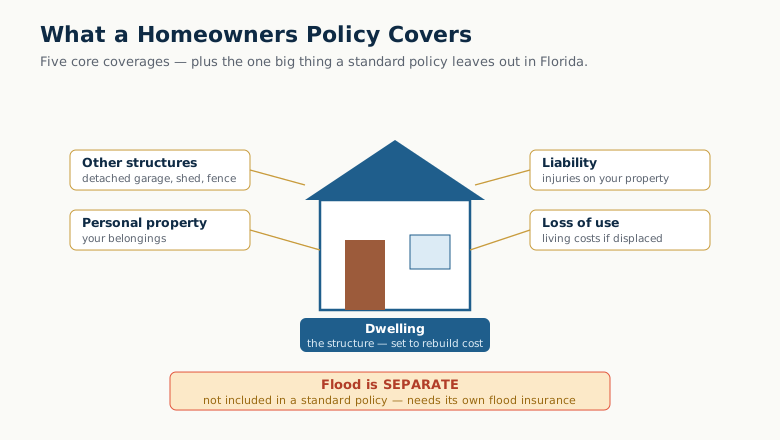
A standard policy bundles several coverages, and it pays to know each:
- Dwelling (Coverage A) — the structure of your home. This should be set to the cost to rebuild, not the market price or what you paid.
- Other structures (B) — detached garages, sheds, fences.
- Personal property (C) — your belongings.
- Loss of use (D) — living expenses if your home is uninhabitable after a covered loss.
- Liability (E) and medical payments (F) — if someone is injured on your property.
Replacement cost vs. actual cash value
This distinction matters enormously. Replacement cost pays to repair or replace without deducting for age and wear. Actual cash value (ACV) subtracts depreciation, so you get far less — this comes up most often with older roofs, where some Florida insurers now offer only ACV roof coverage. Always know which you have, especially on the roof.
The Florida deductible reality
Florida policies generally carry two deductibles:
- A standard deductible (a flat amount) for everyday claims.
- A separate hurricane deductible for named-storm damage — usually a percentage of your dwelling coverage (often 2%, 5%, or 10%), not a flat dollar amount. On a $400,000 home, a 2% hurricane deductible is $8,000. Know this number before a storm.
Flood is separate — and critical in Florida
This surprises many homeowners: standard homeowners insurance does not cover flood. Flood is a separate policy (through the NFIP or private insurers), and it typically has a 30-day waiting period, so it can’t be bought once a storm is approaching. Given Florida’s geography, flood coverage deserves serious consideration even outside designated flood zones. We cover storm timing in our hurricane readiness guide.
How to lower your premium
You have more control than you might think:
- Get a wind mitigation inspection. This is the big one — it documents wind-resistant features and earns recurring discounts, often paying for itself the first year. See how wind mitigation lowers your insurance.
- Keep your roof in good shape. Roof age and condition drive both your premium and your insurability — the focus of our roof care guide.
- Be ready for a 4-point inspection. Older homes often need a 4-point inspection (roof, HVAC, electrical, plumbing) before a carrier will write or renew a policy.
- Raise your deductible if you can absorb it — it lowers your premium, but be sure you could actually pay it.
- Bundle and shop. Compare carriers, and revisit your policy each year. Our Insurance Hub and Florida insurance market guides help you compare.
Read the exclusions
Two policies at the same price can cover very different things. Pay attention to roof coverage (RCV vs ACV), water-damage limits, screen enclosure and pool cage coverage, and any cosmetic exclusions. The cheapest policy is rarely the best value if it leaves you exposed where Florida homes actually get hurt.
Document your home — your claim depends on it
Whatever policy you choose, document your home now: photos or video of every room and the exterior, plus an inventory of valuables, stored somewhere safe. This is your evidence if you ever need to file, and it speeds up everything.
Where an inspection fits in
A current inspection is one of the most useful things you can bring to an insurance decision. It tells you your roof’s real condition and remaining life, surfaces the safety issues carriers care about, and tells you whether you’re ready for a wind mitigation or 4-point inspection to capture savings. Pair this with the case for annual inspections, and when you’re ready, schedule an inspection so you’re negotiating your coverage from a position of knowledge — not guesswork.
← All Notices